Best EV Chargers to Pair with Commercial Solar Systems in 2026: Cost, Features & ROI Guide
- Why Pair EV Chargers with Commercial Solar?
- Types of Commercial EV Chargers
- Level 2 AC Chargers
- DC Fast Chargers
- Best Commercial EV Chargers in 2026
- Level 2 vs DC Fast Charging
- Commercial EV Charger Installation Costs
- Premium vs Budget Commercial EV Chargers
- Example Commercial Solar + EV Charging Cost Calculation
- Investment
- Features to Look for in Commercial EV Chargers
- Smart Load Management
- Solar Integration
- Remote Monitoring
- Fleet Scheduling
- Payment Processing
- OCPP Compatibility
- Industries That Benefit Most
- Tips for Maximizing ROI
- State-Specific Notes
- Texas
- Florida
- California
- Frequently Asked Questions
- Can commercial solar fully power EV chargers?
- Which charger type is best for office buildings?
- Are DC Fast Chargers worth the investment?
- Can businesses earn revenue from EV charging?
- Should battery storage be added?
- How long do commercial EV chargers last?
- Conclusion
Electric vehicles (EVs) are becoming a standard part of commercial fleets, employee transportation, and customer amenities. At the same time, businesses are investing heavily in commercial solar systems to reduce electricity expenses and achieve sustainability goals.
Combining commercial solar panels with EV charging stations creates one of the highest-value clean energy investments available in 2026. Businesses can power electric vehicles using renewable energy, lower utility costs, improve Environmental, Social, and Governance (ESG) performance, and even generate additional revenue through public charging services.
However, not every EV charger is suitable for commercial solar applications. Charging speed, power requirements, software capabilities, load management, and compatibility with solar systems all influence long-term return on investment (ROI).
This guide explains the best commercial EV chargers, compares charging technologies, outlines installation costs, and helps businesses choose the right solution for their facility.
Why Pair EV Chargers with Commercial Solar?
Installing EV chargers alongside a commercial solar system provides several financial and operational advantages.
Key benefits include:
- Lower electricity costs by using solar-generated power
- Reduced demand charges through intelligent energy management
- Improved employee benefits
- Additional customer attraction for retail businesses
- New revenue opportunities through paid charging
- Reduced fleet operating costs
- Higher property value
- Enhanced sustainability credentials
For many businesses, solar-powered EV charging significantly shortens the payback period compared to installing chargers powered solely by the utility grid.
Types of Commercial EV Chargers
Level 2 AC Chargers
Level 2 chargers are the most common solution for businesses.
Typical charging speed:
20–60 miles of driving range per hour.
Best suited for:
- Employee parking
- Hotels
- Apartment complexes
- Shopping centers
- Office buildings
Advantages:
- Lower installation cost
- Efficient daytime charging with solar
- Minimal infrastructure upgrades
- Easy scalability
DC Fast Chargers
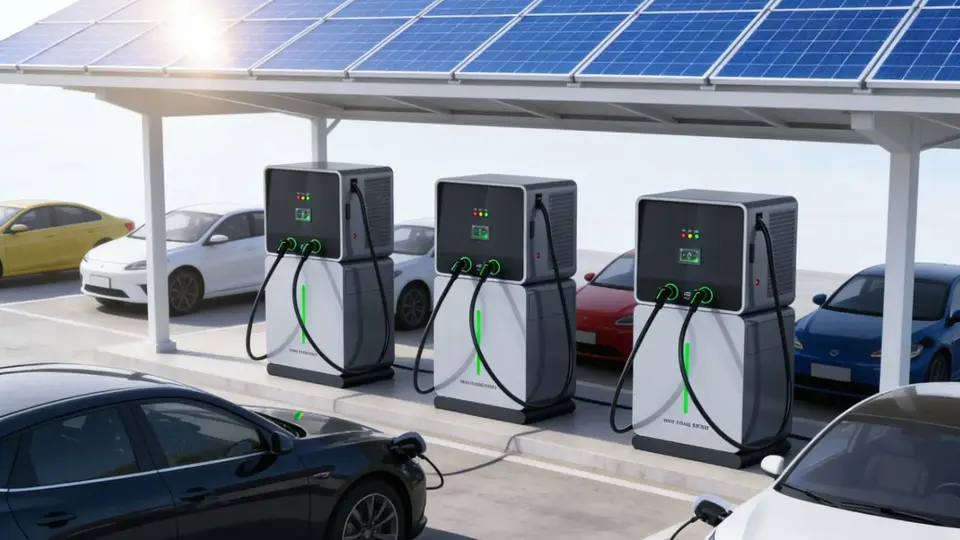
DC Fast Chargers deliver significantly higher charging speeds.
Typical charging speed:
100–250+ miles of range in approximately 20–40 minutes.
Best suited for:
- Fleet depots
- Highway businesses
- Retail centers
- Truck stops
- Logistics companies
Advantages:
- Rapid charging
- High customer turnover
- Commercial fleet support
Disadvantages:
- Higher equipment cost
- Greater electrical infrastructure requirements
Best Commercial EV Chargers in 2026
| Brand | Charger Type | Maximum Power | Best For |
|---|---|---|---|
| ChargePoint Express Plus | DC Fast | Up to 500 kW | Public charging |
| ABB Terra 360 | DC Fast | 360 kW | Fleet operations |
| Tesla Universal Wall Connector | Level 2 | 11.5 kW | Offices & hotels |
| Blink IQ 200 | Level 2 | 19.2 kW | Employee parking |
| Wallbox Supernova | DC Fast | 180 kW | Retail businesses |
| Siemens VersiCharge XL | Level 2 | 19.2 kW | Commercial buildings |
These chargers support modern networking features, payment systems, remote diagnostics, and compatibility with commercial energy management platforms.
Level 2 vs DC Fast Charging
| Feature | Level 2 | DC Fast |
| Installation Cost | Lower | Higher |
| Charging Speed | Moderate | Very Fast |
| Best Use | Employees & long stays | Fleets & public charging |
| Electrical Demand | Moderate | High |
| Solar Compatibility | Excellent | Excellent with battery storage |
| ROI | High | High in high-traffic locations |
Businesses should select the charger type based on how vehicles use the facility rather than simply choosing the fastest option.
Commercial EV Charger Installation Costs
Average installed costs in 2026:
| Charger Type | Installed Cost |
| Level 2 Single Port | $3,500–$8,000 |
| Dual-Port Level 2 | $7,000–$15,000 |
| 50 kW DC Fast Charger | $35,000–$70,000 |
| 150 kW DC Fast Charger | $80,000–$150,000 |
| 350 kW Ultra Fast Charger | $180,000–$350,000 |
Costs vary based on:
- Electrical upgrades
- Transformer capacity
- Trenching
- Permits
- Utility interconnection
- Software subscriptions
- Network management features
Premium vs Budget Commercial EV Chargers
| Feature | Premium Chargers | Budget Chargers |
| Smart Monitoring | Advanced | Basic |
| Remote Diagnostics | Yes | Limited |
| Payment Integration | Full | Limited |
| Warranty | 5–10 Years | 2–5 Years |
| Fleet Management | Excellent | Basic |
| Energy Management | Advanced | Standard |
Premium systems often reduce operating costs through advanced load balancing and predictive maintenance.
Example Commercial Solar + EV Charging Cost Calculation
A corporate office installs:
- 250 kW commercial solar system
- Six dual-port Level 2 EV chargers
Investment
Solar installation:
$550,000
EV charging equipment:
$72,000
Electrical upgrades:
$25,000
Total investment:
$647,000
Federal Investment Tax Credit (30% on eligible solar components):
-$165,000
Estimated net investment:
$482,000
Annual electricity savings:
$92,000
Annual EV charging revenue:
$38,000
Annual maintenance:
$6,500
Estimated annual net benefit:
Approximately $123,500
Estimated payback period:
Around 3.9 years
Businesses offering paid charging services can further improve ROI depending on charger utilization rates.
Features to Look for in Commercial EV Chargers
Modern commercial charging stations should include:
Smart Load Management
Automatically distributes available electrical capacity among multiple chargers.
Solar Integration
Coordinates charging sessions with solar production to maximize renewable energy usage.
Remote Monitoring
Allows facility managers to track charger performance in real time.
Fleet Scheduling
Supports commercial fleet charging during optimal energy production hours.
Payment Processing
Enables businesses to generate revenue from customer charging sessions.
OCPP Compatibility
Open Charge Point Protocol (OCPP) ensures compatibility with various software management platforms.
Industries That Benefit Most
Commercial EV charging combined with solar delivers excellent value for:
- Hotels and resorts
- Shopping centers
- Office parks
- Manufacturing facilities
- Fleet operators
- Distribution centers
- Hospitals
- Universities
- Apartment communities
- Municipal buildings
Each industry benefits from lower operating costs while enhancing sustainability initiatives.
Tips for Maximizing ROI
Businesses can improve investment returns by:
- Charging primarily during peak solar production hours.
- Combining EV chargers with battery storage to reduce demand charges.
- Applying for federal, state, and utility incentive programs.
- Installing scalable charging infrastructure for future expansion.
- Using smart energy management software to optimize charging schedules.
- Selecting chargers compatible with multiple EV brands.
- Monitoring charger utilization and adjusting pricing strategies.
- Performing routine maintenance to maximize equipment lifespan.
State-Specific Notes
Texas
Texas offers excellent solar production and rapidly growing EV adoption. Businesses can reduce high summer electricity costs by scheduling daytime vehicle charging directly from solar generation. Fleet operators also benefit from lower fuel expenses.
Florida
Florida's tourism industry creates strong demand for hotel and retail EV charging. Businesses should install weather-resistant charging equipment capable of withstanding humidity, salt air, and hurricane conditions.
California
California remains the leading market for commercial EV infrastructure. High electricity rates, advanced clean energy regulations, and generous incentive programs make pairing solar with EV charging one of the most profitable energy investments for businesses.
Frequently Asked Questions
Can commercial solar fully power EV chargers?
Yes. Properly sized commercial solar systems can offset part or all of the electricity used by EV chargers, depending on charging demand and available sunlight.
Which charger type is best for office buildings?
Level 2 chargers are generally the best choice because employees typically remain parked for several hours during the workday.
Are DC Fast Chargers worth the investment?
For fleet operators, logistics companies, and high-traffic commercial locations, DC Fast Chargers often provide excellent ROI due to faster charging and increased customer turnover.
Can businesses earn revenue from EV charging?
Yes. Many commercial charging stations support payment processing, allowing businesses to charge customers or visitors for electricity usage.
Should battery storage be added?
Battery storage is highly beneficial when businesses want to reduce demand charges, improve resilience during outages, or support fast charging during peak periods.
How long do commercial EV chargers last?
Most commercial charging stations have an expected lifespan of 10–15 years, with proper maintenance and software updates extending operational life.
Conclusion
Pairing commercial solar systems with EV charging stations is one of the smartest long-term investments businesses can make in 2026. Solar-powered charging reduces electricity costs, supports corporate sustainability goals, enhances customer and employee satisfaction, and can even generate new revenue streams through public charging services.
For most businesses, Level 2 chargers provide the best balance of affordability, scalability, and daily convenience, while DC Fast Chargers are ideal for fleet operations and high-traffic commercial locations. Selecting chargers with advanced energy management, remote monitoring, and solar integration ensures maximum efficiency and long-term value.
Before investing, compare equipment options, evaluate expected charging demand, explore available incentives, and work with experienced commercial solar and EV infrastructure professionals. A well-designed solar-powered EV charging system can significantly reduce operating expenses while positioning your business for the growing electric transportation economy.